


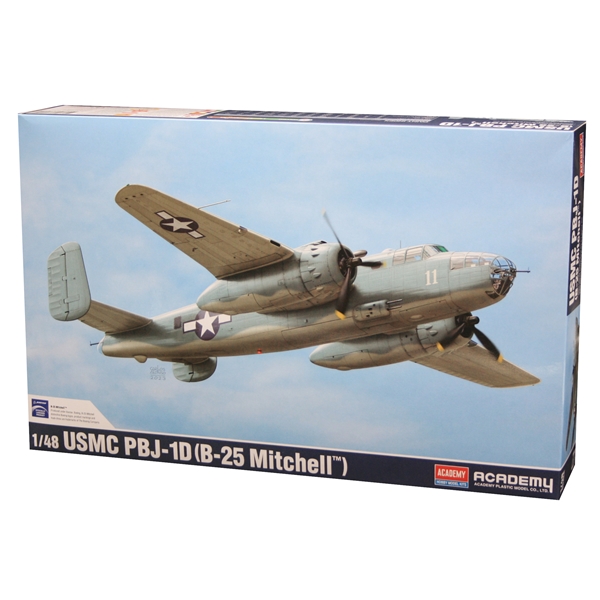
In March 1939, the US Army Air Corps issued a specification for a medium bomber capable of carrying a 2,400 lb (1,100 kg) payload over a distance of 1,200 miles (1,900 km) at a speed of 300 mph (480 km/h). North American Aviation (NAA) used its NA-40B design as the basis for the NA-62, which was submitted for the contract to become the new medium bomber. With no YB-25 prototype yet available, the Air Corps ordered the NA-62 into production in September 1939, designating it the B-25, alongside the Martin B-26 Marauder, another new medium bomber.
Production and Design Evolution:
The first B-25s were produced in North American’s Kansas City factory, which began churning out bombers in large numbers in 1942. Early production models, however, faced some design issues. The B-25 initially featured a constant dihedral wing design—meaning the wing angle remained consistent from the fuselage to the wingtip. This caused stability problems, which were addressed by redesigning the outer wing panels just beyond the engine nacelles, resulting in the signature gull-wing configuration that would define the B-25’s appearance.
In addition to the wing redesign, minor adjustments were made to improve the aircraft’s stability, including enlarging the tail fins and reducing the inward tilt at the top of the tail. These changes improved both the aerodynamics and handling of the aircraft.
As production continued through 1940 and 1941, various versions of the B-25 were developed. The B-25A and B-25B models entered service with the US Army Air Forces (USAAF) in 1942, with the B-25B being the first operational version. In response to evolving combat needs, further developments led to the introduction of the B-25C and B-25D variants later in 1942. By this time, the B-25 was already in widespread use across multiple theaters of the war.
Cannon-armed Variants and Further Developments:
The combat demands of the war prompted even more specialized versions of the B-25. In 1942, NAA began work on the B-25G, a variant armed with powerful nose-mounted cannons for ground attack and strafing missions. This version was followed by the B-25H, which carried even more firepower. Production of these cannon-armed variants continued through the B-25J and B-25J2, with the B-25H particularly notable for its role as a gunship.
The concept of the B-25 as a gunship emerged in late 1942 when NAA sent a technical representative to the South West Pacific Area (SWPA) to evaluate the need for a more heavily armed version. The B-25G was the first factory-produced variant to feature a dedicated gunship role, followed by the B-25H, which further enhanced the aircraft’s offensive capabilities.
As the B-25J was produced, it returned to its primary bomber role but could also be outfitted as a strafer, depending on mission requirements. Throughout the war, the B-25 continued to be modified and adapted for various roles, proving to be an incredibly versatile and effective aircraft.
Key B-25 Variants:
- B-25A & B-25B: Early production models, with the B-25B being the first operational version in 1942.
- B-25C & B-25D: Updates with improved features, such as greater durability and better avionics.
- B-25G: The first version with a cannon-mounted nose, designed for ground-attack missions.
- B-25H: A more heavily armed gunship variant.
- B-25J & B-25J2: Continued evolution of the bomber, capable of being outfitted as a strafer.
The B-25 Mitchell’s long service life and versatility made it one of the most successful American bombers of World War II, with thousands produced and deployed in a variety of combat roles.


Reviews
There are no reviews yet.