1/24 Fiat Abarth 695SS DISC
8 August 2025
1/35 West German Flakpanzer Gepard
8 August 2025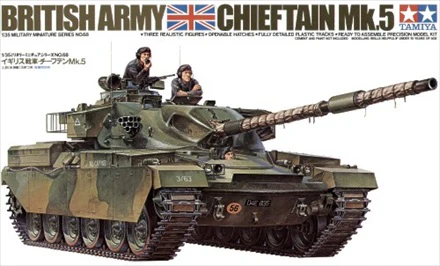
1/35 British Chieftain Mk.V Tank
R350,00
The Chieftain Tank is one of the best known of the present generation of battlefield weapons, and is one of the most heavily armoured and armed fighting vehicles in service anywhere today. It has not been without its detractors or critics, however, and there has been a running debate by military commentators for several years past on the relative merits of the British Chieftain Tank compared with the main battle tanks of other great military powers- the United States, Soviet Russia, France and West Germany – whose present equivalent designs afford a fascinating contrast with Chieftain in many key aspects.
The Chieftain, however, was developed as a result of British tank experience in World War II and after, and reflects the priorities which British tank men felt to be the most important terms of firepower, protection and mobility. British tank development in World War II resulted in the famous Centurion, which first appeared in 1945 in the closing weeks of the war. The Centurion, together with the Soviet T-34/85, and German Panther, represented the culmination of thinking (arising from actual experience) which pointed the need for a “universal” tank had, meanwhile, been disturbed by the appearance of the Soviet Josef Stalin II tank in 1945, with a powerful 122mm gun.
More significant still, however, was that the British by this time had a new tank in production, the Chieftain, which was to replace both the Centurion and Conqueror, with firepower superior to both. Initial studies for a new “medium tank gun” to replace these two tanks started in the early 1950’s and by 1954 some definite proposals had been formulated by the British General Staff. It was planned that the new vehicle should not exceed 50 tons in weight, should have a gun of 120mm calibre, low sloped superstructure, particularly at the front, and a new, compact V-8 engine instead of the Meteor engine of the Centurion. It was originally thought that the maximum calibre of the gun would be no greater than 105mm, due to the weight and size of the 120mm round in a vehicle of relatively small size, buth this problem was overcome by developing a 120mm round with bagged, as opposed to cased charges, as used in large calibre naval guns. In the event, the 105mm gun was developed and fitted to later marks of the Centurion, and the 120mm gun became feasible for the new design. The new tank was originally designated “Medium Gun Tank No.2 FV 4201” and the contract for design work went to Leyland Motors, who had been main contractors for Centurion.
Development of the Chieftain since it entered production is best seen by summarising the various models: Chiftain Mk. I: About 40 of these vehicles were built, largely for extended troop trials and training. After test service with 1st and 5th RTR, the type was cleared for service in 1963. A distinguishing feature was the split hatches to the cupola similar to those on later types of Centurion.
Chieftain MK. 2: This was the definitive production version which first went into service (with the 11th Hussars) in 1967. It had a one piece cupola hatch and special ventilation equipment on the turret rear to enable the vehicle to operate closed down in nuclear and biologival warfare conditions. The armour plating on the light projector was reduced, round stowage reduced, and snorkel wading equipment was supplied in place of a floatation kit originally envisaged. This type saw extensive service in the late 1960’s and early 1970’s, and indeed, the Chieftain rapidly replaced the Centurion as the British Army’s main battle tank once production was under way. Special purpose models- a recovery vehicle, AURE, and bridgelayer have appeared.
Chieftain Mk 3: This version appeared in 1969 and had a better auxiliary generator and detail improvements to the engine. The L60 engine proved complex, and successive marks of the Chieftain have had the engine gradually uprated to give the full designed power output. An improved cupola, and modified internal stowage were other changes.
Chieftain Mk 3/3: This saw a big step forward, in that the fire control arrangements were modified so that an advanced laser sight for the gunner can be fitted.
Chieftain Mk 5: First announced in 1970, this was the main type in service in the mid 1970’s. Further engine modifications bring the power output up to 750bph, with consequent improvement in overall performance, and revision of the ammunition stowage arrangements enabled 64 rounds to be stowed. Splash plates have been added on the glacis.
The Chieftain has been compared, inevitably, with the French AMX-30, the West German Leopard, and the US M60A1. All these tanks have speed and mobility superior to the Chieftain and are lighter in weight. They also have the 105 mm gun and are inferior to the Chieftain in firepower and armour. Whether mobility or firepower will be the most crucial to top quality in any European major war has yet to be put to the test, but the pace of the technology in armoured warfare is relentless. The Soviets have made big progress with fin-established ammunition (in their T-62 and new T-72 battle tanks) and the Israeli-Arab “Yom Kippur” war of October, 1973 showed for the first time that the main battle tank was very vulnerable to tactical anti-tank missiles skilfully employed. It may be, therefore, that the Chieftain could be the last of the traditional type of tank in the form in which it has been accepted for many years past. Whatever the future, however, Chieftain remains an exciting and powerful fighting vehicle. It has been ordered by the Iranian Army and has interested many others, though the great expense of one of these vehicles limits their availability.
Related products
-
Tamiya German Marder 3
R350,00 -
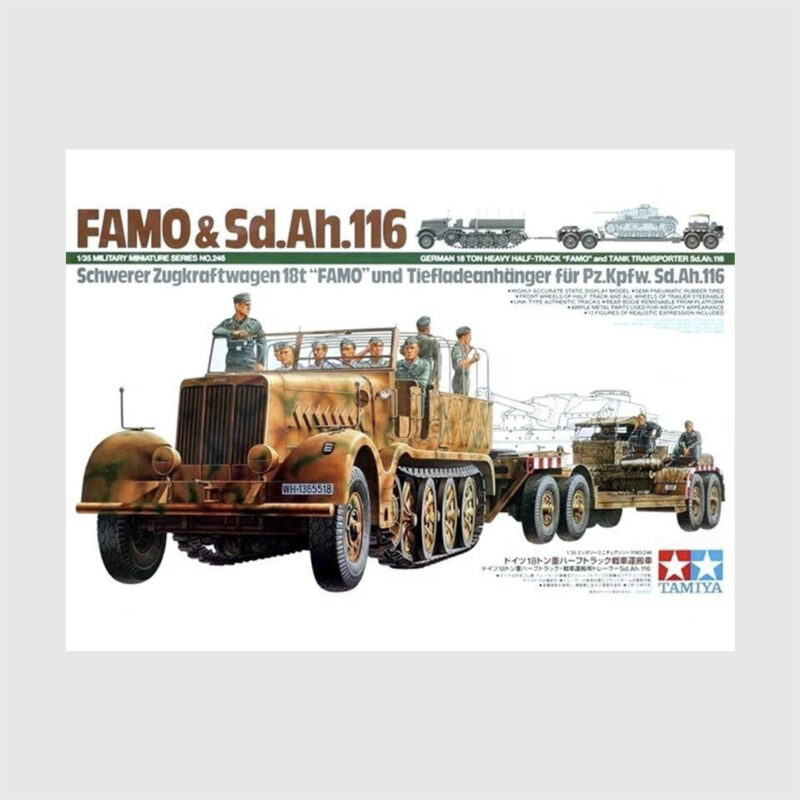
Tamiya FAMO SD116
R2800,00